31 December 2009

Stem Invention

It's amazing what a difference a deadline makes. I've been puzzling over a build problem for several weeks now, without success. None of my boat building books has a solution. Even Clem Kuhlig's "Building the Skiff Cabin Boy" just skips over the problem.

Here's the problem: The backbone of the skiff consists of the stem in the front, the keelson along the bottom, and the transom in the back. The stem has to go from about where my hand is in the picture below, down to the leading edge of the ladder frame. What makes this complicated is that the angle and position of the stem is very important, and I knew I'd have to fool around with it a bit to get it right.

So how could I hold the stem in place in a way that was easily adjustable, but also very strong?


The stem needs to go from where my hand is, down to the frame.
photo jalmberg

As of yesterday, I had no idea how to do this. But once I gave myself a deadline, it suddenly came to me this morning. What I needed was something like a clothespin clamp.

I built a custom clamp out of scrap wood so it would closely fit the stem, shown in the photo below.


Building a custom clothespin clamp
photo jalmberg

Here it is assembled.

 
Assembled clothespin clamp
photo jalmberg

Then I screwed it to the leading edge of the ladder frame, right on the center line. This is important, because of course the stem needs to line up with the center line.


Clamp screwed strongly into frame
photo jalmberg

Then I inserted the top of the stem into the clothespin jaws, and tightened up the whole system with a C clamp.

Amazingly, I can now adjust the position and angle of the stem as much as I need to, and when I tighten the clamp, it is held firmly in place. I'm sure this micro-invention has been discovered by many builders, but I was pretty proud of myself, nevertheless.


Strong, adjustable stem clamp
photo jalmberg

Once I finished the stem clamp, I cut the notch in the bottom of the stem that will accept both the keelson and the bottom plank. Then I reinstalled the stem and adjusted it until everything fit right.

The keelson will be bolted to the stem using a long, countersunk bolt through the keelson and stem.

 
Notched stem in place
photo jalmberg

And that was Day 19. Tomorrow, I must tackle the transom. I still have no idea how to clamp that in place, so if you have any ideas, please comment below or email them to john (at) unlikelyboatbuilder (dot) com.

>>> Next Episode: Year of the Blue Moon


I hope you're enjoying "The Unlikely Boat Builder" as much as I enjoy writing it. Some people have asked for a way to be notified automatically when I post new episodes. I've figured out how to do this, so if you'd like to be notified, please click on the link below. I promise I'll never spam you (and Google will have my head if I do.)

Thanks for your interest!

-- John

30 December 2009

Plan B

I write software. To write software, you think about the problem, invent a possible solution, and make a plan to implement that solution.

The problem is, this plan -- call it 'Plan A' -- almost never works. Unexpected hitches develop, the problem changes, new opportunities emerge. These factors, and many more, conspire to make Plan A obsolete or unattainable.

For many years, I found this frustrating. I went to RPI for engineering. I graduated out of SUNY Albany's math department. What I and many of my fellow software Project Managers searched for was a better Plan A. One that wouldn't change, and that would guarantee that software would be delivered on time, on schedule.


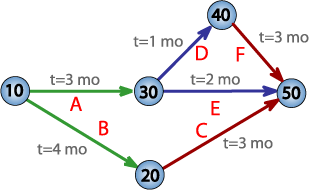
An imaginary plan -- a Pert Chart
Wikimedia Commons

This, as the software world discovered many years later, was an unachievable goal. Building a software program is not like building a house. It is not an engineering process that can be managed with Gannt diagrams or PERT charts. Writing a new piece of software is more like a voyage of discovery, requiring energy, resourcefulness, creativity -- and a large dollop of positive thinking.


A real plan -- Captain Cook's Voyages
Wikimedia Commons

You still need a Plan A, of course. In the same way that people seem to be wired to believe the unbelievable, people are wired to need a plan: a set of goals, and a plan to achieve them. It's hard to make dinner without a plan. So, whether you keep your plans in your head or turn your computer screen into a Post-it® fringed checklist, you probably have a Plan A for whatever it is you're doing.

But -- and this is a big 'but' -- you also need a Plan B. Because if Plan A fails, or priorities change, or new opportunities emerge, you're going to need a Plan B.

And here's the great thing: As Captain Cook knew, there's always a Plan B.

Thus, when the wooden boat that Helena and I had been looking for for years, turned up on eBay, we needed a Plan B.

Our boating Plan A had been "build Cabin Boy this winter so when and if we buy a wooden boat, I'll know how to take care of it."

We had grabbed a new opportunity when it knocked on our door, and we now owned a boat. A boat in Florida -- about 2000 nm. from home. Clearly, Plan A was no longer operative.

So here's Plan B: to sail the new boat home from Florida in stages. Stage 1, the north west coast of Florida to the south east coast of Florida, via the Keys, commencing in 20 days.

And for this voyage of discovery, I'd need a dingy, which means instead of taking all winter building Cabin Boy, I need to finish it in 20 days. Will I be able to finish Cabin Boy in 20 days? Who knows, but I'm going to give it the best I've got!

The Keelson

The keelson, in Cabin Boy, is a structural member that ties the stem and stern together, and supports the bottom planking. Specifically, it's a 8' x 5" x 7/16" piece of white oak.

The piece of white oak I bought from Condon's was a bit bigger than this, so the first order of business today was to trim it down to size. I did this using my bi-polar bandsaw, which happened to be in a good mood today...


Trimming keelson to 5" wide
photo jalmberg

To save time and money, I decided this morning to build Cabin Boy to "work boat" standards. In other words, cheap and cheerful. But I'd been wanting to try out my new old plane, so couldn't resist giving it a few quick swipes. That's my copy of "Restoring, Tuning & Using Classic Woodworking Tools" by Michael Dunbar. Great book!


Using my new old plane. Sharp!
photo jalmberg

Next, it was time to notch the forms so the keelson would lie flush with the bottom of the boat. The bottom planks will eventually go on top of the keelson. Or under, depending on how you look at it.


Seeing how it looks -- but the keelson needs to be *in* the forms, not on them.
photo jalmberg

I used my Japanese pull saw to cut the notches. I wish I'd remembered the neat trick on page 127 of Rossel's "Building Small Boats", which is to clamp a strip of wood to the saw as a fence or depth guide, but forgot and just cut by eye.


To cut notches, first make a bunch of small cuts, all to the same depth.
photo jalmberg

I worried that these notches would be hard to cut, but it was much easier than I expected. A little pressure with a chisel just popped the pieces of wood out. The bottom was a bit rough, but a few strokes of the chisel leveled the bottom so it was 'good enough'.


Popping out the cut pieces
photo jalmberg

The result is a nice, clean notch:


Starting to look good
photo jalmberg

This is much easier than it looks. Each notch took 5 minutes at the most to make.

When all the notches were cut and trimmed, Helena and I tested the keelson for fit. Perfect! Notice the rise in Cabin Boy's stern. This is going to make him easy to row and sail.


Testing for fit
photo jalmberg
Beautiful! And that was day 20. Tomorrow, I'll tackle the stem.

Next Episode: Stem Invention

~~~~~~~~~~~~~~~~~~~~~~~

Blog of the Day: John Vigor

I always enjoy John Vigor's blog, but as I contemplate a long sail around the coast of Florida, which will be my longest sail ever, by far, his post today seems particularly apt: Reasons for Singlehanding


I hope you're enjoying "The Unlikely Boat Builder" as much as I enjoy writing it. Some people have asked for a way to be notified automatically when I post new episodes. I've figured out how to do this, so if you'd like to be notified, please click on the link below. I promise I'll never spam you (and Google will have my head if I do.)

Thanks for your interest!

-- John

20 December 2009

Occam's Razor

Believe it or not, I have occasionally been accused of being an expert at finding the hardest way to do things. I come by this talent naturally, my late father being the true expert in this field. However, when it comes to building a wooden boat to a deadline, sometimes the simplest solution is the best.

For the last month or so, I've been asking all my new boat builder/wood worker friends where to buy boat lumber. There are many answers to this question: from a company in Brooklyn that sells wood recovered from 200 year-old buildings (built from old-growth timbers that are no longer available), to a company in New Jersey that supposedly sells wood sawn from White Cedars that fell into Jurassic-era swamps, to small lumber mills hidden away in the dark hollows of New England.

However, there is one company that appears -- with positive or negative comments attached -- on nearly everyone's list: M.L. Condon, of White Plains, NY.

The positive comments tend towards the "they have everything" line. The negatives focus on their supposed high prices and Bimmer driving, Brie eating, yuppie clientele.


Brie - a soft cows' cheese
Wikimedia Commons

Some of my best friends used to be yuppies (before the Crash) and I don't mind a bit of Brie, but the rumors of high prices were a bit of a turnoff, so I almost skipped Condon's even though they were next on my list. I'm sure glad I didn't.

If I haven't made it obvious, yet, I am a bit intimidated by this whole boat lumber buying thing. I've learned a few things from books -- enough to convince Helena, anyway -- but my confident facade crumbles under the fire of one or two questions from a real lumber guy... I'm clearly clueless, and feel that way.

Thus, I pulled up to the smallish-from-the-outside Condon yard with a less than happy feeling in the pit of my stomach.


As soon as I walked into the office, one of the managers greeted me. With a few questions, he gently extracted both my needs and experience level. But instead of using this ammo to shatter my confidence, he simply assigned a yard guy, named Matt, to help me.

Actually, Matt was more than a helper. He was like my personal wood concierge.

As Matt escorted me down to the lumber yard, I discovered that one rumor about Condon's is true: they do have everything, or at least everything I could imagine at the moment.


One tier of lumber at Condon's. There's another on the mezzanine, above.
Photo by jalmberg


Not only do they have everything, it's neatly organized. For some reason, I found the tidy labels reassuring. Even I could understand what I was looking at.


Each bin is organized, the length of each board marked on it's end for easy reference
Photo by jalmberg

Matt helped me find everything I needed. He pulled out planks so I could inspect them, patiently helping me find the one that 'spoke' to me. I made him pull out a lot of planks, and never did he show the slightest frustration. Amazing for this day and age, he seemed to be there to help me.

Mind you, Matt and his boss knew I was only looking for two things: a long oak plank for the keelson, and a piece of mahogany big enough for Cabin Boy's small transom. They knew I was a small fry. It didn't seem to matter... go figure.

Once we found the two pieces of wood I needed, Matt offered to plane them down to the thickness I needed for a few bucks more. I hadn't even thought of this service, but two or three passes through this machine saved me a couple hours of hand-planing.


Matt, milling my transom down to the correct thickness
Photo by jalmberg

Clearly, someone in Condon's management knows what he or she is doing. Not only do they have the wood that boat builders need, they provide the service that makes it accessible, even to clueless newbies like me. If the problem of buying wood has been a problem for you, as it has been for me, their service might get you over the hump.

Finally, a word about prices. All I can say is that they are competitive or better than prices I've seen at other yards in the New York metro area. Admittedly, my wood buying experience is limited. Probably it is possible to buy wood for less at a small mill up in the woods if -- and this is a big if -- you know exactly what you're looking for and can negotiate a better price.

But for a newbie like me, the hand-holding at Condon's was just what I needed to get me over the lumber-buying hump, so I could keep my project moving forward. I add my recommendation to the chorus of happy customers out there.

And maybe next time they'll serve me the Brie!

Next Episode: Plan B


~~~~~~~~~~~~~~~~~~~~~~~~~~~~~~~~

Blog of the Week: Jessica Watson
Jessica Watson is hoping to become the youngest person (not woman) to sail non-stop around the world. Her boat may be pink, but she's headed for Cape Horn.

http://youngestround.blogspot.com/

~~~~~~~~~~~~~~~~~~~~~~~~~~~~~~~~

Video of the Week: Air Drying Your Own Lumber

Buying lumber that's dried and ready to go is great, but it's cheaper to buy green lumber and dry it yourself. If you're the kind of builder who thinks ahead, this video will help get you started.


I hope you're enjoying "The Unlikely Boat Builder" as much as I enjoy writing it. Some people have asked for a way to be notified automatically when I post new episodes. I've figured out how to do this, so if you'd like to be notified, please click on the link below. I promise I'll never spam you (and Google will have my head if I do.)

Thanks for your interest!

-- John

12 December 2009

The Cruelest Lesson

In the olden days (like 3 weeks ago), I thought the one task that separated the dreamers from the builders was lofting. But this week I decided there is another indicator of serious intent, at least for traditional boat builders. It's when your reading list starts to include more wood working books than boat building books.

Through my carefree years as an armchair builder, I enjoyed reading all the boat building books: Chapelle, Roselle, Buehler, Gardner, Pardey, McIntosh, and Atkin.

But reading ain't doing, so as I started making sawdust, it gradually dawned on me that all of the traditional boat building books make the same assumption: that the reader is not a computer programmer or someone equally useless in a boat yard, but an experienced wood worker. Someone who is as comfortable sharpening chisels, as he is with chewing the fat with the boys down at the local sawmill.

Knowing even less about wood working than about boat building, my reading list started to include titles like Restoring, Tuning & Using Classic Woodworking Tools, by Michael Dunbar, and Understanding Wood, by R. Bruce Hoadley.

At first, this diversion seemed innocent enough. It's only natural that an aspiring wooden boat builder would need to learn a bit about tools and wood. After all, what is a boat builder except a fellow with tools, wood, and way too much free time?

But it's a slippery slope. Let me give you an example.

This week, as I started my quest to find the wood to build Cabin Boy, I visited two of the closest lumber yards on my list.


View Boat Lumber in a larger map
My Google map of boat lumber sources near Long Island

Suburban Mills in Huntington Station had a smallish collection of hardwoods in a shed behind the office. One of the guys was very helpful and pulled out various bits of White Oak for my inspection, but he didn't have anything big enough for my keelson, which was the main thing I was looking for.

On the other hand, Roberts Plywood in Deer Park, had enormous slabs of air dried White Oak stashed in a corner of their warehouse. These were 9 or 10 foot long slabs of oak, sawn right through the tree, about 2 inches thick, with bark on both sides. The one that seemed best for my use looked like it weighed about a thousand pounds. Or at least a few hundred.

Whereas I was looking for the equivalent of a nice bit of steak wrapped in plastic, this was an enormous side of beef. Yes, my 5/8" x 5" x 8' keelson was hidden somewhere inside that slab of oak, but how to get it out?

Luckily I was driving Helena's tiny Honda Fit, which would have been crushed like a bug if I lowered that massive monster onto it's roof, so I had a good excuse to retreat and think things over.

For help, I turned to one of my favorite wood working groups, the Old Tools forum on the Web. The galoots on that list patiently explained to me that wood workers turn large chunks of wood into smaller chunks using two techniques:

"Riving" is splitting wood down it's grain. I could use this technique to split the slab from end to end into smaller slabs, that would still be 2" thick.

"Resawing" is sawing wood, particularly to turn one thick plank into two or more thinner planks.

One of the galoots on the Old Tools forum is the author of this week's "Blog of the Week", Bob Easton. Bob pointed me to a fine tutorial that he wrote on Resawing Long Lumber. You should definitely check it out, but in a nutshell, he showed how I could turn that huge slab of oak into any number of smaller parts for Cabin Boy.

In fact, I could probably get all the oak I needed out of that slab, and still have half left over. Since my dingy fund is perpetually short of cash, this was an attractive proposition.

However -- and now we finally come to the nub of this blog post -- to make use of this resawing technique, I'd first need to build a frame saw, which meant buying an old ripsaw, cutting a blade off the saw, removing all the teeth and then recutting and sharpening a new set of teeth, and then mounting this new blade into a frame.

Then I'd need some way to hold the board steady while I sawed it. Bob has some neat stools that are perfect for this, that I could build.

Then I'd need to practice, because resawing this way depends on the woodworker's skill, not mechanical guides, for accuracy. I refer you to Bob's tutorial for complete details.


Frame Saw
Wikipedia Commons


Since anyone interested in traditional boat building is also likely to be attracted to traditional wood working tools and methods, I must say that I was pretty hot on this idea, and still am!

But as I was explaining this little detour to Helena, with much excitement and sketching, she reminded me of my goal of launching Cabin Boy in the spring. Did I really have time for this?

Of course, the answer was no. And here is the nub: both boat building and wood working require learning many interesting skills. Some of which, like rigging, sail making, and the milling of lumber, are big enough to be a profession in themselves.

It is extremely tempting for an enthusiast like myself to get lost on one of these detours. They are so very, very interesting.

But if the newbie boat builder is ever to finish his boat in a reasonable amount of time, he must restrain himself as much as possible. He must dip his toe into each of these oceans of knowledge, learning just what he must before turning to the next task, rather than plunging in head first.

And this, dear reader, is the cruelest boat building lesson I've learned so far.

Next Episode: Occam's Razor


~~~~~~~~~~~~~~~~~~~~~~~~~~~~~~~~


Blog of the Week: Bob Easton -- http://www.bob-easton.com/blog/

Bob is both an experienced boat builder and wood worker, and he loves to share his knowledge with newbies like me. His tutorials, frankly, are mind blowers, and I'd give anything for his work bench. A fantastic resource and the kind of guy I'd like to meet some day. Check it out.

~~~~~~~~~~~~~~~~~~~~~~~~~~~~~~~~

Video of the week: Building the Seabright Skiff

This is a professionally produced video about the making of the traditonal Seabright Skiff by a very experienced boat builder in New Jersey. He makes it look so easy!


Building the Seabright Skiff


I hope you're enjoying "The Unlikely Boat Builder" as much as I enjoy writing it. Some people have asked for a way to be notified automatically when I post new episodes. I've figured out how to do this, so if you'd like to be notified, please click on the link below. I promise I'll never spam you (and Google will have my head if I do.)

Thanks for your interest!

-- John

06 December 2009

The Quest for Wood

Sometimes you have to choose between your boat and your mother.


I'm the one with the big head
Photo by Dad

Working on Cabin Boy has become something of an obsession for me, but when my mom developed some health issues that required her first-born son to fly off to Florida, work on my boat came to a screeching halt. However, as a side effect, I did develop a severe case of BSA (Boat Separation Anxiety.)

To make a long story short, my mom is doing great and I cured my BSA by putting the long hours in doctor's waiting rooms to good use, re-reading Greg Rössel's "Building Small Boats" and drawing up a complete lumber list for Cabin Boy.

Now back in New York, I am ready to tackle what must be a difficult job for all novice boat builders: finding the wood.

And not just any wood, mind you, but the half-inch of wood that will someday be the only thing between my foot and the bottom of the deep blue sea. Or at least the bottom of Huntington Bay.

When John Atkin drew Cabin Boy, he didn't bother to draw up a lumber list. I imagine his audience of hearty, do-it-yourselfers would have been insulted if he had. So it was up to me to study the 5 pages of plans, and to visualize each and every plank and chine and seat riser, so I could add the stick of wood I'd need to my list:


Wood
Size
Backbone


Stem
W Oak
1 3/4" x 4 3/4" x 2'
Keelson
W Oak
5/8" x 5" x 8'
Transom
W Cedar
5/8" x 16" x 38"
Centerboard trunk
W Cedar
3/4" x 4" x 6'


Sides


Chines (2)
W Oak
5/8" x 1 5/8" x 9'
Seat Risers (2)
W Oak
5/8" x 1 5/8" x 9'
Inwales(2)
W Oak
5/8" x 1 5/8" x 9'
Planks (8)
W Cedar
7/16" x 6-12" x 9'
Side frames (8)
W Oak
5/8" x 1 3/4" x 1.2'


Bottom


Cross planks
W Cedar
5/8" x 4" x 60'
Spines (20)
W Cedar
5/8" x 4" x 8'


Seats


Forward thwart
W Cedar
5/8" x 8" x 2' 3"
Center thwart
W Cedar
5/8" x 8" x 3' 8"
Sternsheets
W Cedar
5/8" x 11" x 3'


Other


Knees, breast hook, oar lock doublings
W Oak
5/8" x various
Skeg/stern post/mast step/mast reinforcement under twart/stern knee
W Oak
3/4" x 8" x 4'

By 'W Oak', I mean air-dried White Oak. And by 'W Cedar', I mean air-dried White Cedar, flitch sawn if I can find it.


Atlantic White Cedar Tree
photo: US Fish & Wildlife Svc


Air-dried simply means that the wood, cut 'green' from a log, has been stacked up with small sticks between the boards to allow air ciculation, covered loosely, and allowed to sit quietly for a year or two, drying at it's own pace.

This is opposed to kiln-drying, which speeds up the drying process by circulating warm, dry air through the stack. As far as I know, the wood is not actually baked in kiln.

Like many other elements of boat building, the question of air-drying vs. kiln-drying is fought over with religious fervor. I spent a lot of time studying this question, and as far as I can tell, you can build a good boat using either type of wood. However, I've been told that air-dried is both better and cheaper than kiln-dried. I am hoping that this is so.

[If you have an opinion you'd like to share on this topic, I'd be very glad to hear from you. Please leave a comment below!]

For those with even less experience than me, I can tell you that it is possible to dither over your lumber list for a very long time. But if you want to actually build that boat, eventually you just have to say 'good enough' and go shopping.

That brings me to the next big question: where, exactly, do you buy air-dried White Oak and White Cedar? The guys at Home Depot don't have it. Nor do the big, construction-oriented lumber yards. At least, not on Long Island. I've looked.

No, to acquire genuine, boat-building lumber, you need to seek out small mills in out of the way places, and that is exactly what I intend to do in the next week or so.

To prepare, I've made a list, both for myself, and other newbies in the New York area who stumble upon this blog in the future. The names on this list come from Google, recommendations of helpful builders on the Wooden Boat forum, and adverts in the back of Wooden Boat magazine.

Name
Location
Phone
Roberts Plywood
Deer Park, NY
631-586-7700
Suburban Mills
Huntington Station, NY
631-351-6445
Harned Brothers Saw Mill
Commack, NY
631-864-5911
M.L. Condon
White Planes
914-946-4111
Wood, Steel, & Glas
Madison, CT
203 245 1781
Peter marlowe Forest Products
Guilford, CT
203-457-0304
New England Naval Timbers
CT
860-693-8425
Peter Kitonis
Elmore, VT
802-888-4807
Boulter Plywood Corp
Somerville, MA
617-666-1340
South Jersey Lumberman's
Mays Landing, NJ
609-965-1411

As I said, I haven't paid a visit to any of these mills or yards yet, so I can't personally recommend any of them, but each has been recommended to me by at least one builder.

In the next week or so, I plan to visit as many of these mills and yards as possible, taking lots of pictures and video. I'll relate my buying experiences in future blog posts, and hopefully score the lumber I need to build Cabin Boy!

Again, if you have any experience with these companies that you'd like to share, or would like to recommend other suppliers within a hundred miles or so from New York, please share by leaving a comment below, or by shooting me an email at john@unlikelyboatbuilder.com.

This is going to be fun!


Next Episode: The Cruelest Lesson

~~~~~~~~~~~~~~~~~~~~~~~~

This week's video: Wonder how they sawed wood before electricity? Here's how they did it in Holland.


I hope you're enjoying "The Unlikely Boat Builder" as much as I enjoy writing it. Some people have asked for a way to be notified automatically when I post new episodes. I've just figured out how to do this, so if you'd like to be notified, please click on the link below. I promise I'll never spam you (and Google will have my head if I do.)

Thanks for your interest!

-- John