
Lake Okeechobee from the Rim
photo wikimedia commons
Nemesis was the Greek goddess who took particular pleasure in punishing those who succumbed to the sin of Hubris, or "being out of touch with reality and overestimating one's own competence or capabilities".

Nemesis, by Alfred Rethel (1837)
She's a vengeful angel, but this week, I had her outnumbered 3-1. Let me explain...
4 days ago, I attempted to motor across the lake against a 5-10 knot breeze. That's when my motor died again. I was able to sail back along the twisting, 10 mile channel, back to the town of Clewiston -- one of the few towns on the Okeechobee Waterway with a marina.
The Roland Martin Marine Center was too busy to tackle my problem immediately, so they put me in touch with my first angel -- a very experienced boat mechanic, appropriately named Tommy Barnicle.
Tom diagnosed the problem in about 15 seconds: one of the plastic ports that the fuel lines attach to had developed a crack and thus a fuel leak. Enough gas got through the line to keep the engine running badly, which explains why I could start the engine, and why it stalled when I put it into gear.
4 days ago, I attempted to motor across the lake against a 5-10 knot breeze. That's when my motor died again. I was able to sail back along the twisting, 10 mile channel, back to the town of Clewiston -- one of the few towns on the Okeechobee Waterway with a marina.
The Roland Martin Marine Center was too busy to tackle my problem immediately, so they put me in touch with my first angel -- a very experienced boat mechanic, appropriately named Tommy Barnicle.
Tom diagnosed the problem in about 15 seconds: one of the plastic ports that the fuel lines attach to had developed a crack and thus a fuel leak. Enough gas got through the line to keep the engine running badly, which explains why I could start the engine, and why it stalled when I put it into gear.
As long as I had Tom's attention, I mentioned that the engine had been overheating if I went above 3 knots. He thought that was either the impeller or -- less likely -- the thermostat.
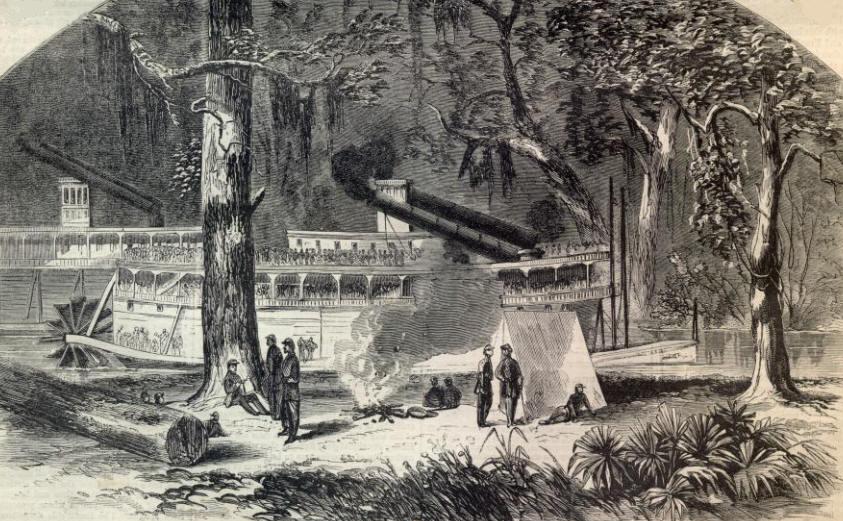
Sketch by Mr. Theodore R. Davis
wikimedia commons
The impeller blade is like the paddle wheel on the back of a stern wheeler, only smaller. With age, the plastic blades develop a curve, which reduces the impeller's pumping efficiency, and thus it can't pump enough water through the system to keep the engine cool.
Just one problem: neither Tom nor any of the other mechanics at the marina could figure out what model engine I had. All the markings had been erased by the sun. The engine's cover was a pure Johnson cream. No trace remained of the company name, design, horse power, etc.
Worse, the model and serial numbers had been bleached right off the information plate affixed to the engine.
The engine's cream color seemed to indicate a Johnson engine, but the only readable label on the engine said 'Bombardier'. And one mechanic noticed that the engine's lower half was clearly made by Suzuki.
In short, they could not figure out what parts to order.
After listening to the debate for an hour or so, I remembered that the marina in Sarasota had already ordered a carburetor repair kit for the engine. Surely they knew the engine model. So called the service manager up there and she confidently gave me the three part numbers. This settled the argument and the parts were ordered with overnight delivery.
Next afternoon, the parts arrived and I thought I was home free. Just one problem. They didn't fit. They were the wrong parts. We were back to square one, not knowing what type of engine we were dealing with.
At this point, I threw in the towel. I had had enough of this lousy engine and decided to buy a new one. Just one problem. After phoning dealers around the state of Florida, I discovered that Florida dealers do not stock outboards for sailboats (which need a special long shaft). It was a special order, which meant a 1-2 week delivery.
Despair started to set in... Was Nemesis going to defeat me?
That is when my second angel came through. Steve D., a reader of this blog, had read about my engine troubles. Amazingly, he contacted me and offered to lend me the engine off the back of his dingy, to help me get to Stuart, where he had a home. All I had to do was arrange to have it picked up.
I normally prefer to solve my own problems, but I was out of options. Steve's stunningly kind offer was a gift from heaven, and I was smart enough not to spurn angels bearing gifts.
So I called on my third angel, my brother Bruce, who lives in Jupiter FL. He jumped into immediate action and picked up the engine from Steve that afternoon. The next day, he drove it the 75 miles to Clewiston, on the west shore of Okeechobee. We installed it on the boat, tested it, and celebrated in the marina's Tiki Bar.
At dawn the next morning, with the sun still a pink hint on the horizon, I prepared to get underway. I was up early, determined to make up for the 4 lost days.
I gave the Yamaha 15 HP 2 stroke engine a pull. It coughed... and died.
I gave the Yamaha 15 HP 2 stroke engine a pull. It coughed... and died.
I pulled the starting cord again... nothing. Again... nothing. No cough, no sputtering, nothing.
Hovering over the west rim of the Okeechobee, Nemesis chuckled... I heard her and, glancing up, saw the skirt of her long robe as she ducked behind a cloud. I shook my fist at her, and sent a blue cloud of curses up to the sky.
I went online. Found the engine's operator's manual. Double checked the fuel connections. Followed all the starting directions to a T...
Nothing. The engine would not start.
It was now 8 am. I'd been trying to start the engine for 2.5 hours. I called Tom at home. I explained the problem to him. He calmly gave me new directions. Directions that were the exact opposite of those in the Yamaha manual.
Important: this tip might save you a lot of grief someday...
Tom told me to push the choke all the way in, and to turn the throttle all the way up.
As I said, this is exactly opposite to the Yamaha starting instructions, which are to pull the choke out and keep the throttle at the low, starting position. I mentioned this to Tom, doubtfully. He said, just try it.
I did, and the engine started on the second pull.
After leaping for joy (not a great idea on a boat), and telling Tom he was a genius, a genius! he quietly explained that I had flooded the engine. Pushing the choke off minimized the fuel being injected into the engine. Opening the throttle all the way maximized the amount of air mixed into the fuel. And that's what's needed to start a flooded engine: little fuel, lots of air.
I will never forget this tip, and if you have a 2-stroke engine -- even if it's on your lawn mower -- it's a good trick to know.
A few minutes later, the anchor was up and I was on my way again. Over my shoulder, I heard a howl of disappointment, and one angry crack of thunder from out of the clear blue sky.
I resisted the urge to turn and laugh in Nemesis's face... My three angels had beaten her this time, but I still had a long way to go...
If you enjoyed this episode of the Unlikely Boat Builder, please consider telling a friend about it, or posting a link on Facebook. Thanks!
Get Notified Automatically
I hope you're enjoying "The Unlikely Boat Builder" as much as I enjoy writing it. Over 250 people have asked for a way to be notified automatically when I post new episodes. I've figured out how to do this, so if you'd like to be notified, please click on the link below. I promise I'll never spam you (and Google will have my head if I do.)
Thanks for your interest!
-- John
Follow me on Twitter! My son Chris has been bugging me for a few weeks to use Twitter to make short, more frequent posts from my iPhone, for when I don't have the time for longer blog posts. I don't know how it will work out, but I'm willing to give it a try! My Twitter ID is UnlikelyVoyager (UnlikelyBoatBuilder is too long, apparently), and the URL is http://twitter.com/UnlikelyVoyager. Twitter me back, or leave a comment below, if you think this is worth while. Thanks, Chris!


Been concerned as we had not heard from you...yes, the gods do challenge us...but sometimes we win a little.
ReplyDeleteWhen you get out of FL and on up....I am in NC and would help with anything you might need.
It is such a joy to read your blogs and feel along with you the joys and frustrations.
Thank you my friend.
Sometimes I'm just too busy to blog, but the main reason is that I run my battery down and don't have enough juice to charge my laptop.
ReplyDeleteI'm going to be buying a new outboard soon, and one feature it will definitely have is an alternator, so that should solve the battery issue. Solar is great, but sometimes its just not enough to keep up.
Hope to be in NC soon, but no idea what 'soon' means. I've given up trying to set time-type goals. There are too many unknowns. I'm hoping this shake down cruise has uncovered the majority of my and the Blue Moon's weaknesses, but you just never know.
Thanks!
If I'm honest, sometimes it takes me a couple days to get enough perspective on a problem to write about it. Engine problems definitely fall into that category! You would not want to have my day-by-day feelings about that darn engine! I'd have to change my blog rating to 'R'.
ReplyDeleteThat flooded engine trick works on 4 stroke engines too. ;-)
ReplyDeleteAnonymous #4 says
ReplyDeleteHere is something to help you have sweet dreams by.
http://marine.honda.com/Products/modeldetail/BF15
Remember that every venture out on your own boat can be like a shake down cruise. You prepare for every possible unknown and still stuff happens. Stuff happens - all you can do is be ready.
Fantastic trip and blog and pics - stay dry !
And for your AM wake up call - we have the Beach Boys with Sloop John B
http://www.youtube.com/watch?v=fdov2UIjUpY
Outboards can be a hassle. I have reamed out the coolant passages of a Suzuki 2-stroke on a dock at Orcas Island. I have beat and cursed a British Seagull while drifting in the Strait of Juan de Fuca. I also de-gummed the carb jet of a Honda 4-stroke at a dock on the Columbia River. (I highly recommend a Honda 4-stroke of any age.) There is one bit of diagnosis, however, that might free you from outboard worries for good. If I could, I would come down there and help you figure out how to sail your boat to windward in a 5 to 10 knot breeze. Maybe my style is just different, but none of my sailboats would be motoring to windward in 5, 10, 15 or 20 knots. We might heave to in 30 knots or not, depending on whether we were racing.
ReplyDeleteAfter flying my Piper Cherokee on a hot day I pull up to the gas pump, top off the tank and try starting--to no avail. The mechanic cnmes along and shows me the 'hot start procedure'. (Mixture off, throttle full.) Three turns of the prop and she fires. Then I do a quick reversal with throttle out and mixture in. After the embarassing event is over, I remember it forever. Same trick with your outboard engine. My sailing days here on Lake Huron are probably over due to health problems and 79 yrs. have reduced my agility until I can't do foredeck work, anyway. But, John, I'm sailing along with you in spirit. My Westerly Cirrus has gone to abler hands but my memories will last forever.
ReplyDeleteGodspeed and Fair Winds.
John ex-skipper of S/V Bobber Ann
Hey Mike, You know he's sailing upwind in channels, right?
ReplyDelete